
The fluoride content describes the concentration of fluoride ions (F⁻) in a water sample or other liquids. Fluoride occurs naturally in soils, rocks and waters and can therefore be present in different concentrations in groundwater, drinking water or surface water.
The determination of fluoride content plays an important role in water analysis, environmental monitoring, research and various industrial applications. Regular measurements allow changes in water composition to be reliably recorded and documented.
Why is the fluoride content measured?
The analysis of the fluoride content is used to monitor and assess water samples in different areas of application. Fluoride concentrations can vary depending on the origin and composition of the water.
The measurement is used, among other things, for
- Drinking water analyses
- Groundwater investigations
- Environmental monitoring
- Laboratory analysis
- Industrial applications
- Research facilities
Regular monitoring supports the reliable monitoring of water quality and enables the documentation of long-term changes.
How is the fluoride content measured?
Special fluoride measuring devices and ion-selective electrodes are used to precisely determine the fluoride content. These sensors react specifically to fluoride ions in the sample and allow the concentration to be measured directly.
Modern fluoride measuring devices provide fast and reproducible results and are suitable for both laboratory applications and on-site measurements.
What factors influence the fluoride content?
The concentration of fluoride in a water sample can be determined by various natural and technical influences.
The most important factors include:
- Geological composition of the subsoil
- Mineral composition of the water
- Industrial influences
- Water treatment processes
- Natural fluctuations in bodies of water
For this reason, the fluoride content is often monitored as part of comprehensive water analyses.
Typical areas of application for fluoride measurement
Drinking water analysis
The determination of the fluoride content supports the evaluation and monitoring of drinking water samples.
Environmental monitoring
When testing groundwater, rivers and lakes, fluoride measurement provides important information about the composition of the water.
Research and laboratory
In scientific institutions and laboratories, fluoride analysis is used to examine a wide variety of water samples.
Industry
The monitoring of fluoride concentrations can also be relevant for quality control in industrial processes.
Fluoride measuring devices from Apera Instruments
Apera Instruments offers precise measurement solutions for the determination of fluoride ions in water samples. The devices are suitable for laboratory applications, environmental analysis, research and industrial measurement tasks.
Thanks to modern sensor technology, simple calibration and high measurement accuracy, Apera fluoride meters provide reliable and reproducible measurement results.
Frequently Asked Questions
What is the permissible fluoride level in drinking water?
In Germany, the Drinking Water Ordinance (TrinkwV) sets a limit of 1.5 mg/l for fluoride in drinking water. The WHO recommends the same limit. In some regions, fluoride is intentionally added to drinking water (0.7–1.0 mg/l) to reduce tooth decay—though this is not common practice in Germany.
How is fluoride measured in water?
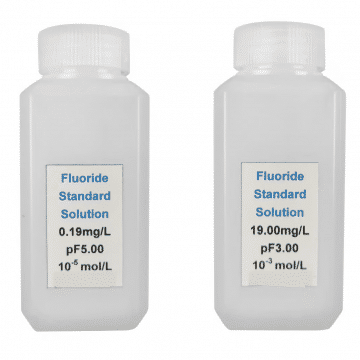
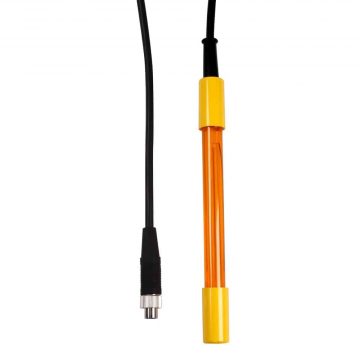
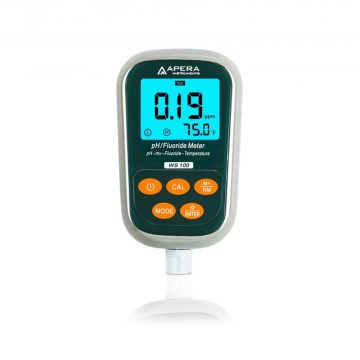
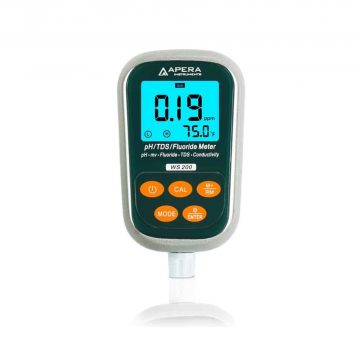
Fluoride is measured using ion-selective electrodes (ISE). The electrode reacts specifically to fluoride ions and emits an electrical signal that is converted into a concentration value. With the F501-S electrode and the WS100 and WS200 meters, Apera offers complete systems for precise fluoride measurements.
Why is it important to measure fluoride levels in groundwater?
In certain geological regions, fluoride naturally leaches from rocks into groundwater. Excessively high fluoride concentrations can cause fluorosis—damage to teeth and bones—if ingested over the long term. Regular measurements are therefore essential for drinking water monitoring and groundwater protection.
Does the pH level affect fluoride measurements?
Yes, the pH value significantly affects the fluoride measurement. For accurate results, the pH of the sample should be between 5 and 8. If the pH is too low, fluoride forms complexes with hydrogen (HF) that are not detected by the electrode. A buffer solution (TISAB) is therefore often used for sample preparation.
Which devices are suitable for professional fluoride measurement?
With the WS100 (fluoride/pH) and the WS200 (fluoride/pH/conductivity), Apera offers specialized measuring instruments for laboratory and field applications. When used in combination with the F501-S fluoride ion electrode and calibration standards, these devices enable precise measurements in accordance with current standards.