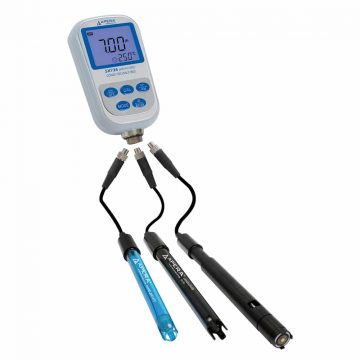

Electrical conductivity (EC) describes the ability of a liquid to conduct electrical current. It is one of the most important measured variables in water analysis and provides information about the concentration of dissolved ions in the water. These ions include sodium, potassium, calcium, magnesium and chlorides, for example.
The more dissolved salts and minerals there are in the water, the higher the electrical conductivity usually is. EC measurement is therefore often used to assess water quality and to monitor processes in industry, agriculture, laboratories and water treatment.
What is electrical conductivity?
Electrical conductivity is usually referred to as the EC value. It describes how well a solution can conduct electric current.
Pure distilled water only has a very low conductivity. Only dissolved ions increase the ability of water to transport electricity. Conductivity is therefore an important indicator of the concentration of dissolved substances in a liquid.
Why is EC measurement important?
The conductivity measurement enables a quick assessment of the water quality and the concentration of dissolved substances. Changes in the EC value can indicate changes in the water composition, impurities or fluctuations in the nutrient content.
The measurement of electrical conductivity is used, among other things, for
- Drinking water analyses
- Water treatment
- Aquaristics and fish farming
- Hydroponics and plant breeding
- Agriculture
- Environmental monitoring
- Industrial process control
- Laboratory applications
The EC value is often used to monitor the concentration of available nutrients in the water, particularly in plant cultivation.
How is conductivity measured?
Special conductivity meters are used for precise measurements. These determine the electrical conductivity of a liquid using a conductivity electrode or probe.
Modern EC measuring devices record the measured values within a few seconds and often have automatic temperature compensation. This means that reliable measurement results can be achieved even with changing temperatures.
Conductivity, TDS and salinity: What’s the difference?
Electrical conductivity is closely related to other water parameters such as TDS (Total Dissolved Solids) and salinity.
- Conductivity (EC) measures the ability of a solution to conduct electrical current.
- TDS describes the estimated total amount of dissolved substances.
- Salt content (salinity) indicates the concentration of dissolved salts.
Many modern measuring devices can therefore determine and display several of these parameters simultaneously.
What factors influence conductivity?
The conductivity of a liquid is influenced by various factors:
- Concentration of dissolved ions
- Salt and mineral content
- Sample temperature
- Chemical composition
- Impurities and additives
As the temperature has a direct influence on the measured value, professional EC measuring devices often have automatic temperature compensation.
Typical areas of application for conductivity measurement
Water treatment
Conductivity is used to monitor drinking water, process water and purified water. Changes can indicate fluctuations in water quality.
Agriculture and hydroponics
The EC value helps to monitor the nutrient concentration in irrigation systems and nutrient solutions.
Aquaristics
Regular EC measurement supports the control of stable water conditions for fish and plants.
Industry and laboratory
In industrial processes and laboratory applications, conductivity is often used for quality control and process monitoring.
Conductivity meters from Apera Instruments
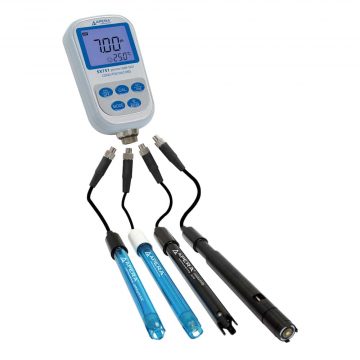
Apera Instruments offers a wide range of EC measuring devices for professional and private applications. The range includes compact Pocket Testers, portable measuring systems and high-precision laboratory devices for demanding analyses.
Thanks to modern sensor technology, automatic temperature compensation and high measuring accuracy, Apera conductivity meters enable reliable monitoring of water quality in a wide range of applications.
Recommended meters: The EC20 Value Pocket Tester is ideal for quick use, while the EC60 Premium Pocket Tester is suitable for additional TDS and salinity measurements. If you also want to measure pH, choose the PC60 5-in-1 multi-parameter meter. You can find detailed instructions for taking measurements under “How do I measure conductivity?” and specific target values for hydroponic cultivation under “EC Value for Hydroponics.”
Frequently Asked Questions
What is a good EC value for drinking water?
According to the Drinking Water Ordinance, a conductivity value of up to 2,500 µS/cm at 20 °C is considered acceptable in Germany. Good drinking water typically has a conductivity between 200 and 800 µS/cm. Distilled or very soft water can have a conductivity significantly lower than that.
What is the correct EC value for hydroponics?
In hydroponic systems, the optimal EC value depends on the plant species and growth stage. As a general rule, 1.2 to 2.0 mS/cm is considered a guideline for seedlings and young plants, and 2.0 to 3.5 mS/cm for mature plants. EC values that are too high inhibit water uptake by the roots.
What is the difference between EC, TDS, and salinity?
EC (electrical conductivity) is the directly measured value in µS/cm or mS/cm. TDS (Total Dissolved Solids) is calculated from the EC value and indicates the total amount of dissolved solids in ppm or ppt. Salinity is also a value derived from EC, specifically for the concentration of dissolved salts.
What is a normal EC level for an aquarium?
For freshwater aquariums, the typical EC value ranges between 200 and 500 µS/cm, depending on the fish species. Fish that prefer soft water, such as discus, prefer values below 200 µS/cm, while cichlids tolerate higher values. Saltwater aquariums have significantly higher conductivity values due to their high salt content.
Do I need to calibrate a conductivity meter?
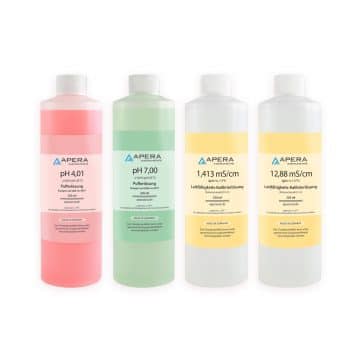
Yes, regular calibration is necessary to ensure accurate measurement results. Apera devices such as the EC20 or EC60 support automatic 1- to 2-point calibration with buffer recognition. The calibration solutions are included with each unit. Calibration should always be performed before first use and after prolonged storage.
-
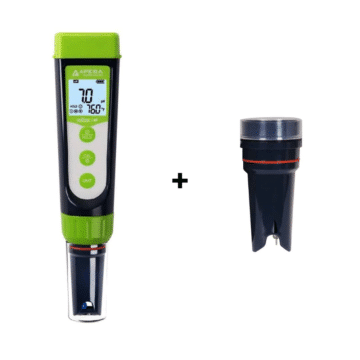
 GroStar™ GS4 pH/EC Pocket Tester + ORP Electrode262.99 €
 -
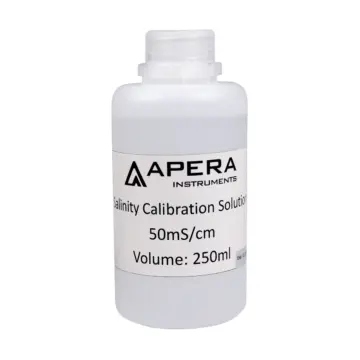
Conductivity Calibration Solution 50 mS/cm17.85 €(0.07 € / 1 ml)
-
Conductivity Calibration Solution 111.8 mS/cm28.56 €(0.11 € / 1 ml)
-
SX655 Conductivity Electrode Replacement for SX650 Conductivity Meter44.03 €
-
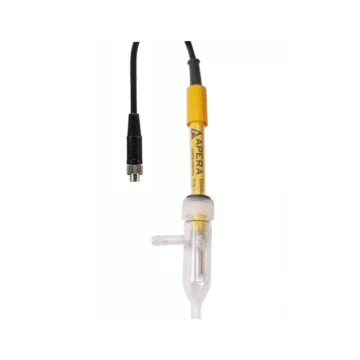
DJS-0.1-S Conductivity/Temperature Electrode for Pure Water, 8-pin261.80 €
-
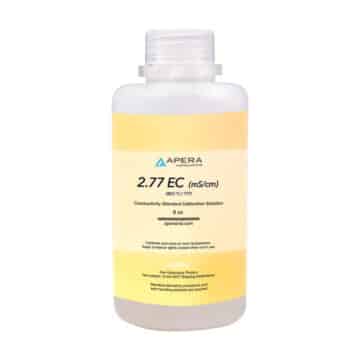
Conductance calibration solution 2.77 mS/cm17.85 €(71.40 € / 1 L)
-
PCO60-Z Smart Multiparameter Meter309.40 €
-
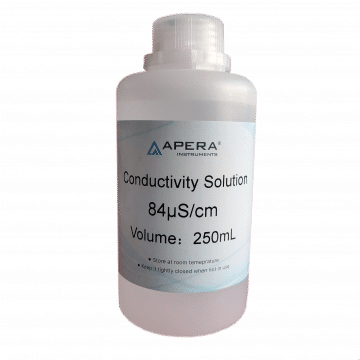
EC Calibration Solution 0.084 mS/cm17.85 €(71.40 € / 1 L)
-
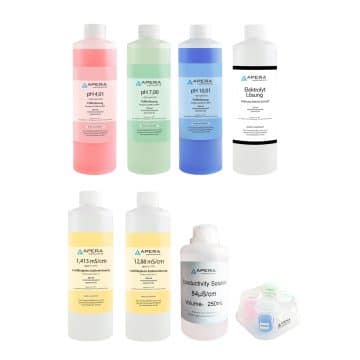
Calibration solution set pH 4.01 / 7.00 / 10.01 + 84 μS / 1413 μS / 12.88 mS + 3M KCl incl. CalBox95.20 €
-
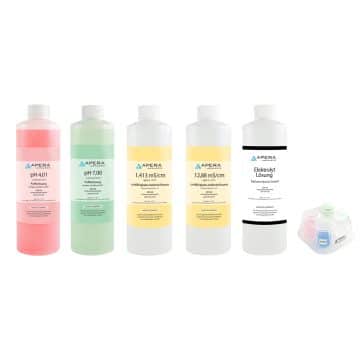
Calibration solution set pH 4.01 / 7.00 + 1.413 / 12.88 mS + 3M KCl incl. Calbox59.50 €
-
Calibration solution set pH 4.01 / 7.00 + 1.413 / 12.88 mS44.03 €
-
GS4-E pH/Conductivity Electrode85.68 €
-
GS3-E Conductivity Electrode53.55 €
-
SX751 portable pH/Dissolved Oxygen (DO)/ORP/Conductivity (EC)/TDS/Salinity/Resistivity Meter946.05 €
-
SX736 portable pH/Conductivity (EC)/TDS/Salinity/Resistivity/Dissolved Oxygen (DO) Meter856.80 €