

The pH value is one of the most important measurement parameters when analyzing liquids. It indicates whether a solution is acidic, neutral or alkaline and influences numerous chemical, biological and technical processes.
Whether in water analysis, hydroponics, aquaculture, food production or in the laboratory: accurate pH measurement is crucial for creating stable conditions and obtaining reliable results.
In this article, you will find out what methods are available for pH measurement, how to use a pH meter correctly and what errors can be avoided.
Why should you measure the pH value?
The pH value influences numerous chemical and biological processes. Even small changes can have an impact on the quality and stability of a liquid.
Typical areas of application:
In water analysis, the pH value helps to assess the quality and stability of water and to initiate suitable treatment measures.
In hydroponics, the pH value directly influences the availability of nutrients for plants. If it is outside the optimum range, important nutrients can no longer be fully absorbed.
In aquaculture, fish and other aquatic organisms are sensitive to pH fluctuations. Regular monitoring protects against stress and losses.
In the food industry, the pH value serves as a quality feature and process control, for example in fermentation, dairy products or meat processing.
In laboratory applications, accurate and reproducible measured values are a prerequisite for reliable results.hydrogen ions and the more acidic the solution. The higher the pH value, the more alkaline it is.
Methods for pH measurement
Various methods are available for determining the pH value. Which one is suitable depends primarily on the required accuracy and the area of application.
pH test strips
Test strips are the easiest way to make a rough estimate of the pH value. A piece of paper coated with indicator dyes is briefly held in the sample. The color of the strip changes depending on the pH value and is then evaluated using a comparison scale.
Advantages:
- Simple application without preparation
- Inexpensive to purchase
- No calibration necessary
Disadvantages:
- Accuracy usually only ±0.5 to 1 pH unit
- Color evaluation is subjective and error-prone
- Hardly usable in cloudy or strongly colored liquids
- No documentation of the measured values possible
Test strips are therefore not suitable for professional applications or repeated measurements.
pH meter
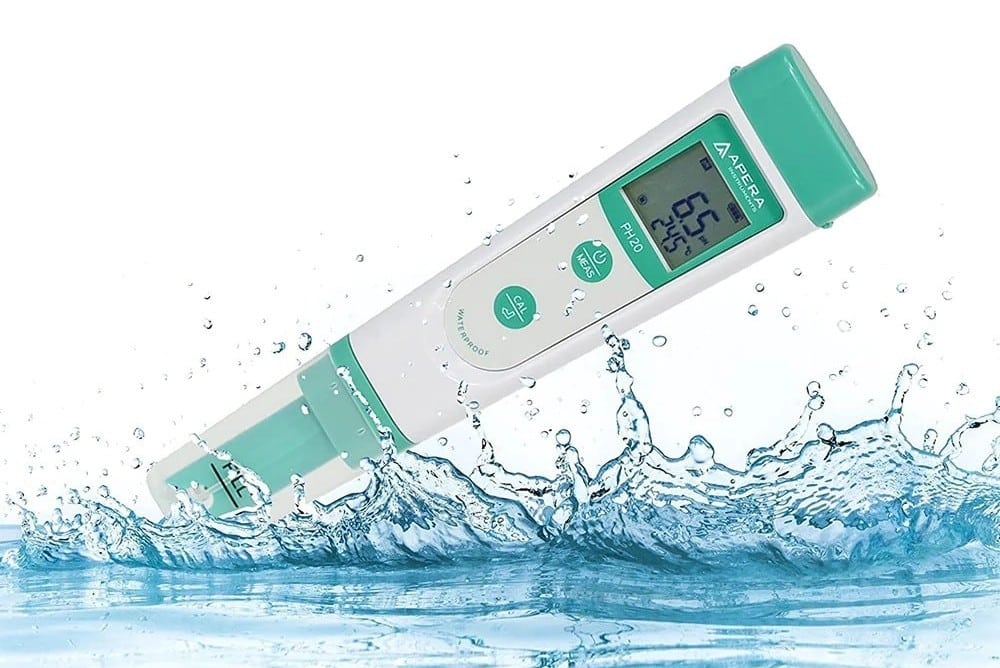
A digital pH meter measures the pH value using a pH electrode. The glass membrane of the electrode reacts to the concentration of hydrogen ions in the sample and generates an electrical signal that is converted into a pH value by the device.
Advantages:
- High measuring accuracy, typically ±0.01 pH
- Fast and reproducible results
- Digital display without subjective evaluation
- Suitable for professional and regular measurements
Test strips or pH meter: What fits when?
| Test strips | pH meter | |
|---|---|---|
| Accuracy | ±0.5 to 1 pH | ±0.01 to 0.1 pH |
| Operation | very simple | Simple, after a short training period |
| Costs | low | Medium to high |
| Calibration required | no | Yes |
| Documentation | not possible | possible |
| Suitable for | rough checks | Precise and regular measurements |
Measuring the pH value correctly: step-by-step instructions
A pH meter only provides reliable results if it is used correctly. The procedure can be divided into five steps.
Step 1: Calibrate
The pH meter should be calibrated before each series of measurements. This involves immersing the electrode successively in buffer solutions with known pH values, for example pH 4.00 and pH 7.00, and adjusting the device accordingly.
Without a recent calibration, measurement errors can creep in that are not detectable to the naked eye.
Learn more: How to properly calibrate a pH meter
Step 2: Rinse the electrode
Before measuring, rinse the electrode with distilled water and then carefully dab with a soft cloth or cellulose. Important: do not rub, as this can damage the sensitive glass membrane.
Step 3: Measure
Immerse the electrode in the sample and ensure that the measuring tip is completely covered. A stable value can be achieved more quickly by gently swirling or stirring. The result is only read off when the device displays a stable value.
Tip: High-quality devices have automatic temperature compensation (ATC). As the pH value is temperature-dependent, ATC ensures that temperature fluctuations do not distort the measurement.
Step 4: Clean the electrode
After the measurement, rinse the electrode again with distilled water to remove sample residues. A special cleaning solution may be useful for challenging samples such as oils or liquids containing protein.
Step 5: Storing the electrode
The electrode must never be stored dry. A dried out glass membrane often does not recover completely. For storage, the electrode should be placed back in the protective cap with electrolyte solution or in a suitable storage solution.
Tap water and distilled water are not suitable as a permanent storage solution.
What factors influence the measurement accuracy?
Measurement errors can occur even with a high-quality device. The most common causes:
Temperature: The pH value of a sample changes with the temperature. Devices with ATC automatically compensate for this effect. Without ATC, measurements at constant room temperature are recommended.
Condition of the electrode: An old, dirty or poorly maintained electrode reacts more slowly and less accurately. Regular maintenance ensures stable measured values and extends the service life.
Calibration: An outdated calibration is one of the most common causes of inaccurate results. Daily calibration is recommended for daily use.
Buffer solutions: Expired or contaminated buffer solutions lead to incorrect calibration points. Buffer solutions should be replaced regularly and never poured back into the original bottle.
Equilibrium time: Taking a reading too early, before the value is stable, will give distorted results. A little patience pays off.
Common errors in pH measurement
- No or outdated calibration:
The most common error. Without an up-to-date calibration, measured values are hardly reliable.
- Electrode stored dry:
Leads to permanent damage to the glass membrane and poorer measurement results.
- Expired buffer solutions:
Falsify the calibration and therefore all subsequent measurements.
- Read too early:
The measured value needs time to stabilize.
- Electrode not rinsed:
Residues from the previous measurement or the storage solution influence the result.
- temperature is not taken into account:
ATC is particularly important for samples that deviate significantly from room temperature.
Conclusion
Reliably measuring the pH value requires the right method and a little care. Test strips are sufficient for a rough guide. If you need accurate, reproducible results, a calibrated pH meter is essential.
With the correct procedure, regular calibration and a well-maintained electrode, stable measured values can be achieved and the service life of the measuring device can be significantly extended.
To the overview of all Apera pH meters
Frequently asked questions about pH measurement
Why do test strips and meters sometimes show different results?
Test strips rely on a visual color reaction, which can be interpreted slightly differently depending on lighting conditions, visual acuity, and the time of reading. A digital pH meter, on the other hand, measures an electrical signal and thus provides reproducible readings with significantly higher resolution, often accurate to 0.01 pH.
Does the water temperature affect the measurement results?
Yes. The electrical signal from the electrode depends on the temperature of the sample, so the same solution can yield slightly different raw readings at different temperatures. That is why most Apera meters feature automatic temperature compensation, which corrects for this effect.
How long does it take to get a reliable pH measurement?
After the electrode is immersed, it usually takes about 30 to 60 seconds for the reading to stabilize. With very cold samples or immediately after cleaning the electrode, it may take a little longer for a reliable reading to be displayed.
Can I measure cloudy or colored liquids?
Yes. Unlike test strips, where the color of the sample can make it difficult to read the result, a digital pH meter works regardless of the liquid’s turbidity or inherent color, since it measures an electrical signal rather than an optical color reaction.
Don’t know the basics yet? What is the pH value?