

At first glance, both devices look similar: they’re portable, waterproof, and come in a convenient carrying case with calibration solutions. Upon closer inspection, however, there are significant differences between the PH20 and the PH60 in terms of accuracy, measurement range, and feature set—differences that can be decisive depending on the application.
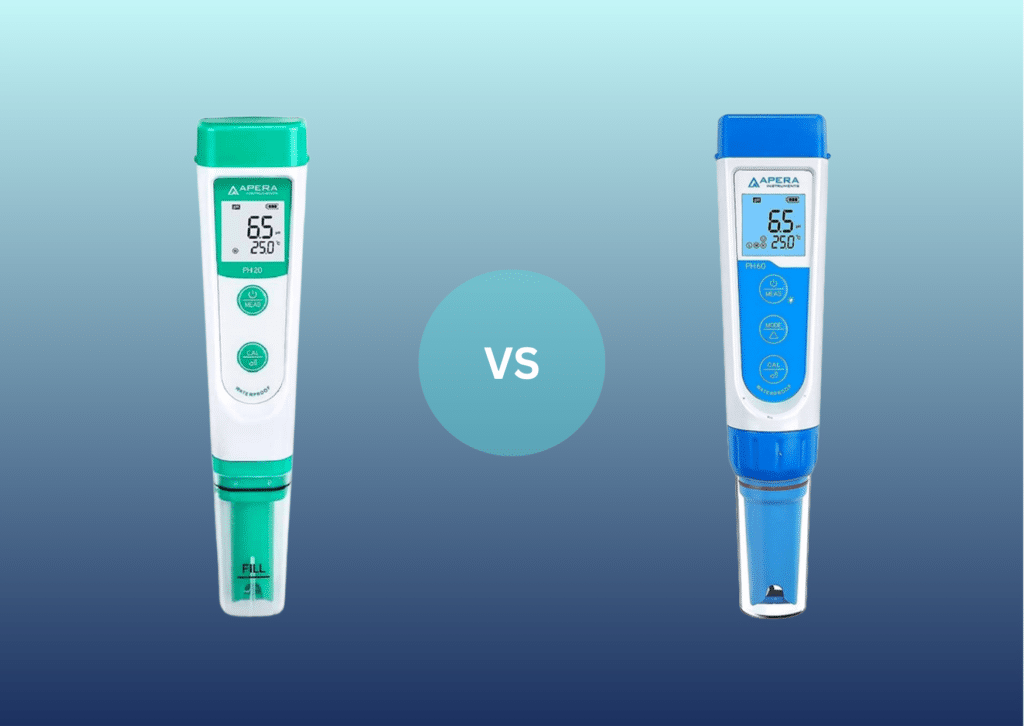
At a Glance
| PH20 | PH60 | |
|---|---|---|
| Price | 83.30 € | €124.95 |
| pH measuring range | 0 to 14,0 | -2.00 to 16.00 |
| pH Accuracy | ±0.1 pH | ±0.01 pH |
| pH Resolution | 0.1 pH | 0.01 pH |
| Supplementary Measurement | temperature only | Temperature, ORP with electrode replacement |
| Calibration | 1- to 3-point, automatic | 1- to 3-point, automatic |
| Protection Class | IP67 | IP67 |
| Power supply | 4 AAA batteries, up to 1,000 hours | 4 AAA batteries, up to 1,000 hours |
The Main Differences
Accuracy and Measurement Range
The PH20 measures with an accuracy of ±0.1 pH in the standard range of 0 to 14. This is more than sufficient for most everyday applications. The PH60 measures with an accuracy of ±0.01 pH—ten times more precise—and also covers the extended range from -2.00 to 16.00, which is relevant, for example, for strongly acidic or strongly basic solutions outside the normal water range.
ORP Additional Function
The biggest functional difference: In addition to pH, the PH60 can also measure the oxidation-reduction potential (ORP), while the PH20 measures only pH and temperature. However, the pH electrode included with the PH60 is not sufficient for this; instead, the replaceable ORP60-E electrode, which is sold separately, is required. So, if you want to assess not only the pH but also the disinfecting power of water—for example, in a pool or in aquaculture—you’ll need the PH60 plus the appropriate electrode, or simply a dedicated ORP meter.
Price and Applications
At €83.30, the PH20 is significantly cheaper than the PH60, which costs €124.95. The extra cost is worth it especially if you actually need the higher accuracy or the ORP function—not just as a general upgrade.
Who is the PH20 suitable for?
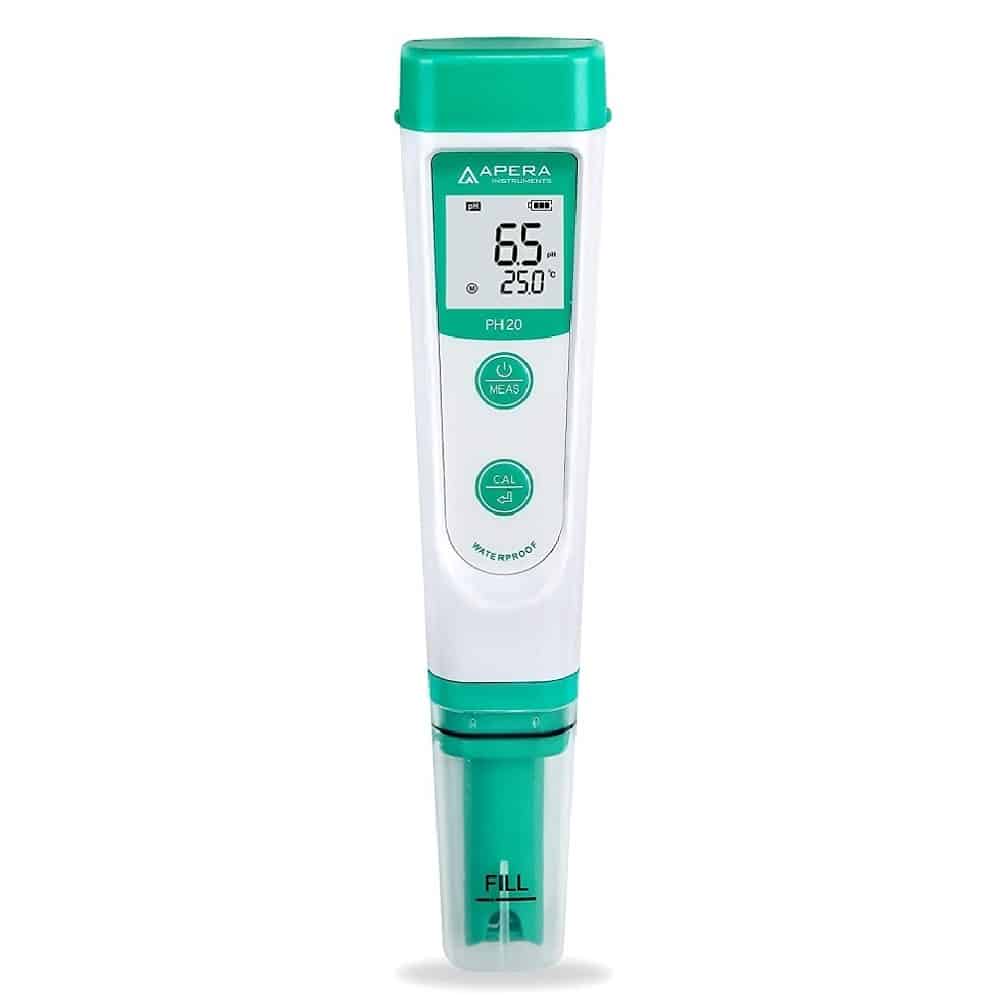
The PH20 is well-suited for hobby applications such as aquariums or garden ponds, where occasional, straightforward pH monitoring is sufficient. Thanks to its lower price, it’s also a solid choice for beginners or as a backup device, as long as ORP measurement isn’t necessary.
Who is the PH60 suitable for?
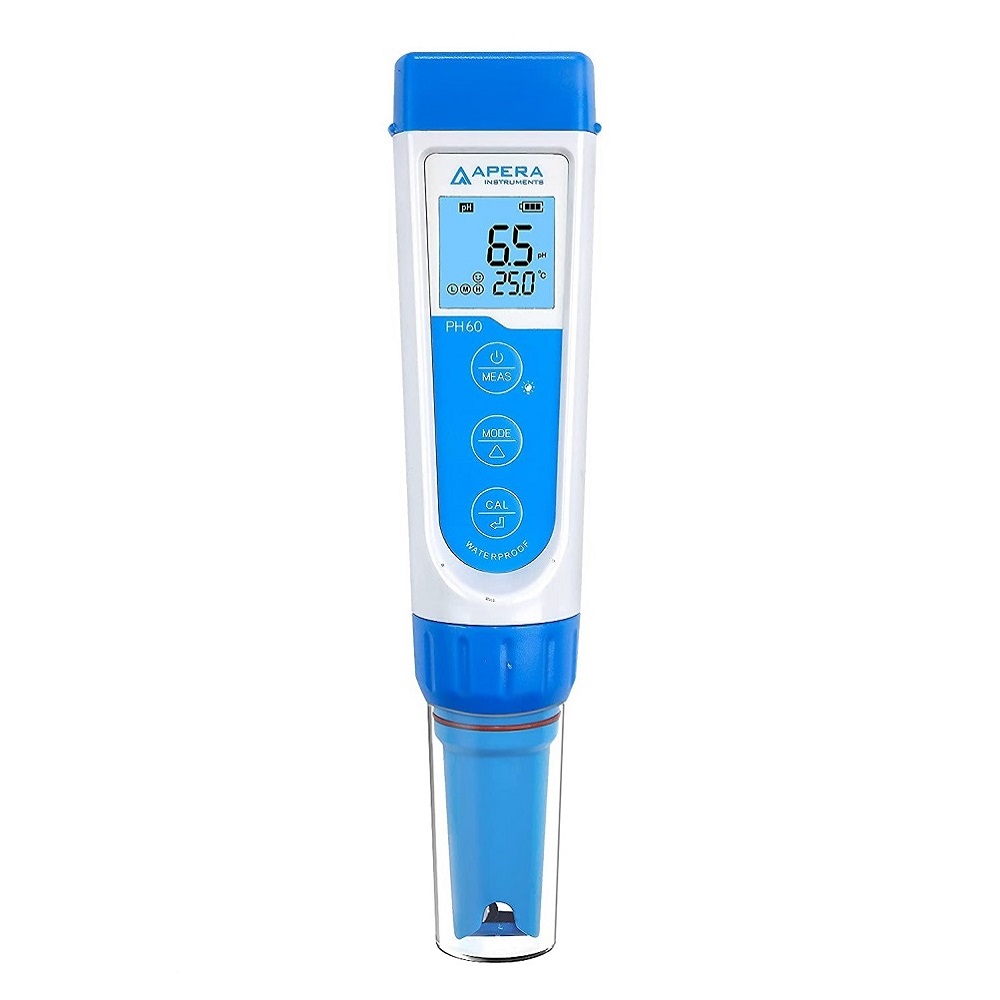
The PH60 is suitable for professional applications requiring high precision, such as in hydroponics, in the laboratory, or anywhere else where redox potential is also a factor when using the optional ORP60-E electrode. Those who take regular measurements and value reliable, more precise readings are better served by the PH60.
Conclusion
For occasional use in an aquarium or garden pond, the PH20 is sufficient and saves money. If you need greater accuracy—or, with the additional ORP60-E electrode, ORP measurement as well—such as in professional or semi-professional settings, the PH60 is the better choice. For those who also want Bluetooth connectivity to the ZenTest app, the PH60-Z is a smart option that offers the same measurement values as the PH60.
Frequently Asked Questions
Is the PH60 suitable for beginners as well, or is it only for professionals?
Yes, the operation is virtually the same as that of the PH20; automatic calibration works just as easily on both devices. The difference lies in the measurement quality, not in the complexity.
Can I also use the PH20 to measure the redox potential (ORP)?
No, the PH20 measures only pH and temperature and is not compatible with an ORP electrode. For ORP measurements, you’ll need at least the PH60 with a compatible electrode or a dedicated ORP meter.
Does the PH60 require an accessory for ORP measurement?
Yes. The included pH electrode measures only pH and temperature. To measure ORP, you must purchase and install the replaceable ORP60-E electrode separately; it is also compatible with the PH60S and PH60F.
Is it worth paying the extra cost to upgrade from the PH20 to the PH60?
It depends on the application. If you only take measurements occasionally as a hobby, you’ll save money with the PH20. If you need greater accuracy or—with an additional electrode—the ORP function, the higher price is justified by the improved measurement quality.
How often do both devices need to be calibrated?
Both models support automatic 1- to 3-point calibration. It is recommended to perform calibration before each important series of measurements or at least once a week if the device is used regularly.
What is the difference between the PH60 and the PH60-Z?
The PH60-Z measures the same values as the PH60, but it also connects to the ZenTest app via Bluetooth to log and analyze the measurements.