

If you grow plants hydroponically, there’s one number you can’t ignore: the EC value. It tells you how much nutrient is actually in your nutrient solution, making it one of the most important factors in determining whether your plants will thrive or become stressed. The problem is that there’s no such thing as “the right EC value.” A basil cutting can tolerate a completely different concentration than a fruiting tomato.
This article provides specific target values for the most common hydroponic plants, explains how to adjust the EC level throughout the growth phase, and highlights the most common mistakes made when taking measurements.
What is the EC value, and why is it so important in hydroponics?
The EC value (electrical conductivity) measures how well your nutrient solution conducts electricity. Since dissolved salts—that is, your fertilizer ions—are responsible for this conductivity, the EC value directly indicates how concentrated your nutrient solution is. In soil, buffering and exchange processes help balance out fluctuations. In hydroponics, this buffering effect does not exist: The roots are directly immersed in the nutrient solution, so any change has an immediate effect.
We’ve already explained in detail how the measurement itself works and what you need to keep in mind during calibration in “How Do I Measure Conductivity? ” Here, we’ll focus specifically on the correct target values for your hydroponic setup.
The Relationship Between EC Value and Nutrient Concentration
It’s important to understand: The EC value measures the total amount of dissolved salts, not their composition. Two nutrient solutions with the same EC value can contain different ratios of nitrogen, potassium, phosphorus, and other elements. So the EC value tells you “how much,” not “exactly what.” It is no substitute for a balanced fertilizer formula, but it is the fastest way to detect over- or under-fertilization early on, before visible deficiency or stress symptoms appear.
Another point that often causes confusion: EC is measured in mS/cm (millisiemens per centimeter), but some devices and nutrient manufacturers use ppm (parts per million) instead. There is no standardized conversion: Depending on the scale (500-scale or 700-scale), the same EC value yields different ppm values. Therefore, it’s best to stick consistently to one unit when comparing values from different sources.
Optimal EC Values for Various Plant Species
The following values are guidelines for mature hydroponic systems at room temperature and are provided for reference only. Depending on the variety, system (NFT, DWC, ebb-and-flow), and light intensity, the optimal concentration may vary slightly.
| Plant | EC value (mS/cm) |
|---|---|
| Seedlings / freshly rooted cuttings | 0.4 to 0.8 |
| Leafy greens, spinach | 0.8 to 1.2 |
| Herbs (basil, mint, chives) | 1.0 to 1.6 |
| Strawberries | 1.2 to 1.8 |
| Cucumbers | 1.7 to 2.5 |
| Bell peppers, chili peppers | 1.8 to 2.5 |
| Tomatoes (Fruiting Stage) | 2.0 to 3.5 |
Seedlings and Cuttings
Young roots are particularly sensitive to high salt concentrations. Start with no more than half the nutrient concentration you’ll eventually use, and increase it gradually as new leaves begin to form.
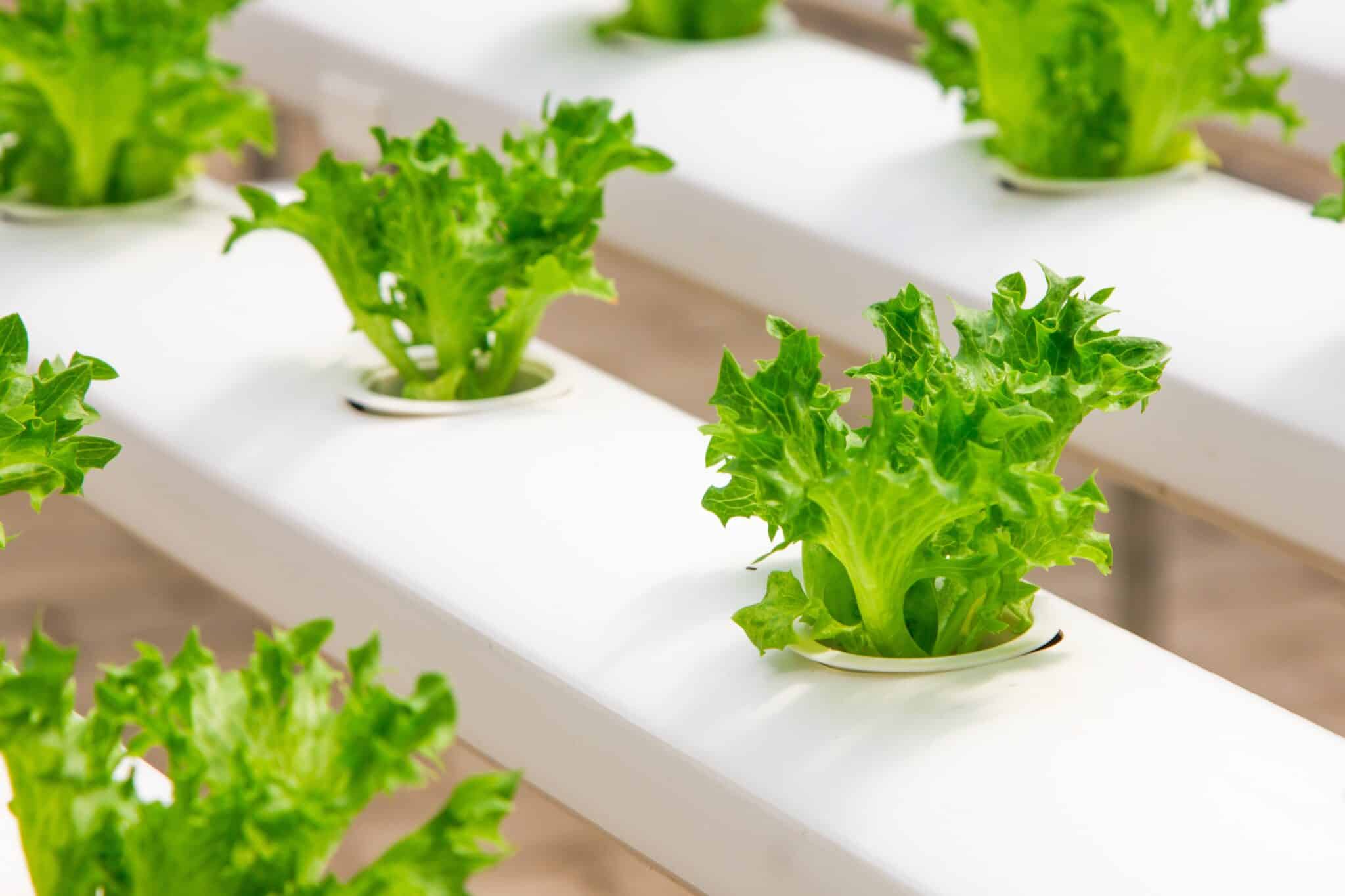
Leafy vegetables (lettuce, spinach, herbs)
These plants grow most consistently at moderate EC levels. Excessively high EC levels often result in a bitter taste and slowed leaf growth, rather than increased yield.
Fruit vegetables (tomatoes, cucumbers, bell peppers)
As soon as the plant begins to flower and set fruit, its nutrient requirements increase significantly. In this case, it’s best to raise the EC level gradually over several weeks rather than changing it abruptly.
Strawberries and Berries
Strawberries are sensitive to fluctuations and prefer a stable, relatively low EC level throughout the entire growing season.
Adjust the EC value throughout the growth phase
The EC level of your nutrient solution changes even without any action on your part: Plants absorb more water than nutrients during the day, which makes the remaining solution more concentrated and causes the EC level to rise. Evaporation further amplifies this effect. Therefore, check the EC level regularly—ideally every day—and adjust it by topping off with pure water (if the EC is too high) or nutrient solution (if the EC is too low). As a rough rule of thumb, the target EC value gradually increases to about two to three times its original level as the plant progresses from the seedling stage to the flowering/fruiting stage.
Common Mistakes in EC Management
- EC value too high: The plant has a harder time absorbing water than salts, leading to nutrient burn on the leaf edges and root damage.
- EC value too low: Deficiency symptoms such as yellowing, stunted growth, and poor flowering and fruit set.
- Don’t forget temperature compensation: The conductivity of a solution changes with temperature. Use a meter with automatic temperature compensation (ATC); otherwise, temperature fluctuations will skew your readings.
- Irregular Calibration: EC electrodes drift over time. Without regular calibration using a reference solution, measurement errors creep in and go unnoticed for weeks.
The Right Meter for Hydroponic EC
For home use, a reliable, easy-to-use meter is perfectly sufficient. A laboratory-grade meter is overkill for most indoor growers and balcony gardeners. A meter that measures EC and pH at the same time is practical, since these two values are closely related in hydroponics.
The PCO60-Z Smart 7-in-1 Multi-Parameter Meter meets exactly this need and is therefore a great way to get started with monitoring your own EC levels. You can also find more information about the technical basics of conductivity measurement on our Conductivity (EC) page.
Conclusion
There is no single “correct” EC value in hydroponics; the plant species and growth stage are always the deciding factors. By using the guidelines in the table as a reference, checking the EC value regularly, and not forgetting to account for temperature, you can avoid the most common causes of growth problems. A reliable meter with stable calibration is essential for obtaining accurate readings.
Frequently Asked Questions
What is a good EC value for hydroponics in general?
There is no universal value; it depends heavily on the plant species and growth stage. A rough range for most hydroponic crops is 0.8 to 3.5 mS/cm; you can find specific target values in the table above.
How often should I measure the EC level in a hydroponic system?
Ideally every day, but at least every two to three days, since the level changes constantly due to water intake and evaporation.
What happens if the EC value is too high?
The plant has difficulty absorbing water, which can lead to nutrient burn along the edges of the leaves, a wilted appearance despite sufficient water, and, over time, root damage.
What happens if the EC value is too low?
The plant is not getting enough nutrients, which is evident in yellowing leaves, slowed growth, and poor flowering or fruit set.
EC or TDS: What’s the difference, and which one should I use?
EC measures electrical conductivity directly; TDS (Total Dissolved Solids) is calculated from this value and depends on the conversion scale used. For everyday hydroponics, EC is the more direct and consistent measurement.
Do I need to take the temperature into account when measuring EC?
Yes. Conductivity depends on temperature, so your meter should have automatic temperature compensation (ATC) to ensure that the readings remain comparable at different water temperatures.