

The IndSen series keeps measuring where laboratory electrodes give up: in hot, corrosive, solids-laden, or sterilized media. Glass membrane, diaphragm, reference system, and electrolyte are designed individually for each application, which is why there isn’t one industrial electrode, but a matching one.
We manufacture all industrial electrodes to order. Tell us what you want to measure, and you’ll receive a recommendation with a quote. If you want to measure individual ions instead of pH or redox, the way leads to our ion-selective electrodes.
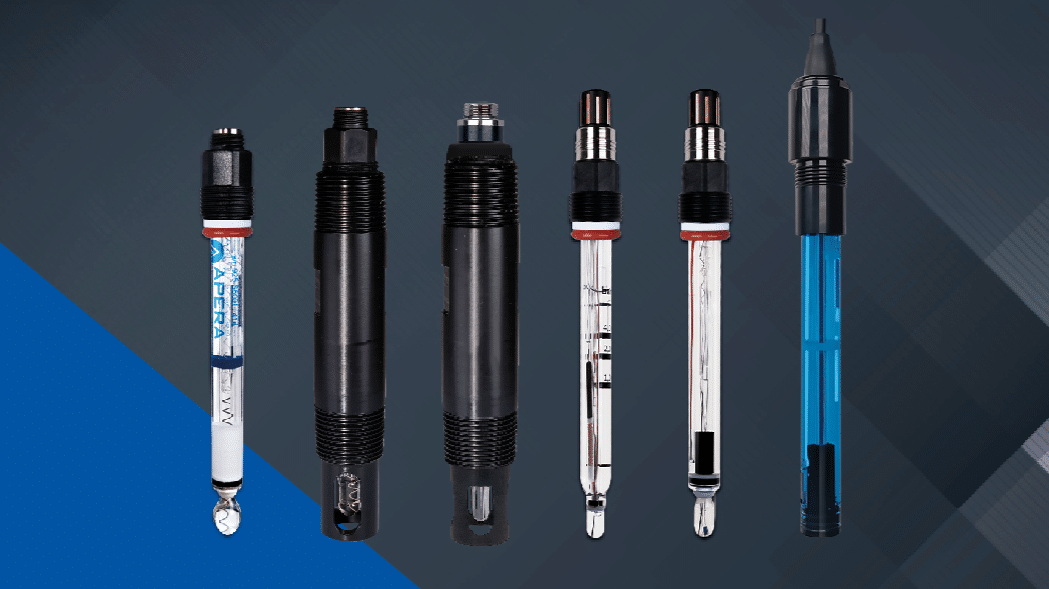
We configure industrial electrodes together with you, which is why you won’t find them in the online shop. Medium, temperature, pressure, process connection, cable length, and temperature sensor determine the right design. Describe your measuring point to us, and we’ll suggest the right electrode and send a quote.
Where IndSen Electrodes Are Used
Compared with laboratory measurement, inline process monitoring places significantly higher demands on stability, reliability, and service life. These six areas cover the majority of inquiries.
- Water treatment: drinking water, cooling water, neutralization, pure water with low ionic strength, and measurements at low temperatures down to -30 °C.
- Wastewater: municipal and industrial wastewater, hydrofluoric-acid-containing wastewater, heavy metal precipitation, and sludge dewatering.
- Chemical industry: chemical production, electroplating, chlor-alkali industry, dyes, petroleum refining, pulp and paper, flue gas neutralization, and desulfurization.
- Pharma and biotechnology: biopharmaceuticals in upstream and downstream processes as well as chemical pharmaceuticals, with in-situ sterilization and autoclaving up to 140 °C.
- Food and beverages: beverages and alcohol, dairy products, yogurt and cheese, sugar and starch, yeast, and cleaning in place.
- Environment: continuous pH measurement in surface water and industrial wastewater, also with a rugged PPS housing.
Four Components Determine Whether the Measurement Holds Up in the Process
Glass membrane, diaphragm, reference system, and reference electrolyte are combined individually for each application in IndSen electrodes. Choosing these four components correctly saves maintenance and downtime later on.
Types of Glass Membrane
The pH-sensitive glass membrane detects the H+ activity in the solution. Glass formulation and membrane shape are among the core technologies of the pH electrode. IndSen membranes are produced on a glass lathe with reinforced walls and are 10 times more stable than those in standard pH sensors.
| Membrane | Property | Typical Application |
|---|---|---|
| HA | Minimal alkaline error | High pH values and high temperatures |
| L | Lowest possible impedance | Solutions with low ionic strength or low temperature |
| HF | Hydrofluoric-acid resistant | Hydrofluoric-acid-containing solutions |
| PHY | Most stable membrane, temperature and chemical resistant | Sterilization and autoclaving |
Available shapes are spherical, hemispherical, cylindrical, flat, olive, and pointed. Cylindrical and olive-shaped membranes increase the surface area and lower the impedance, while flat and pointed shapes meet special installation requirements.
Diaphragm Types
| Type | Behavior | Suitable For |
|---|---|---|
| Ceramic | Porous ceramic material, low electrolyte outflow, prone to fouling and clogging | Water treatment, wastewater treatment plants, industrial processes |
| Open junction | Solid polymer electrolyte in direct contact with the sample, clog-free and maintenance-free | Heavily contaminated media such as paints, oils, and suspensions |
| PTFE ring | Porous PTFE ring, water-repellent, resistant to corrosion and high temperatures | Heavily contaminated, adhesive, or oily media |
Reference Systems
- Long-life reference system: the reference electrolyte contains no silver ions. This prevents the reaction with sulfides or proteins in the sample that would clog the diaphragm.
- Ag+ trap: binds escaping silver ions and keeps the reference electrolyte free of Ag+. Sulfide- and amino-acid-containing samples can no longer poison the reference system.
- Long diffusion path: a long diffusion path and a non-flowing second reference medium significantly delay the diffusion of contaminants and keep the reference potential stable.
Reference Electrolytes
- Polymer electrolyte with open junction: direct sample contact, pressure-resistant up to 6 bar, suitable for nearly all measuring tasks including oily, protein-containing, and low-ionic samples as well as suspensions.
- Pre-pressurized gel: the internal pressure continuously releases small amounts of electrolyte, cleaning the diaphragm. In the Swiss patented process, the internal pressure pushes the gel into a glass capillary, allowing the pressure value to be read from outside.
- Electrolyte with salt reserve: in low-conductivity media, a standard gel-filled electrode drifts by about 15 mV per week. With a salt reserve, it’s about 0.4 mV per week.
Inline pH Electrodes at a Glance
All series are available with the cable connections Cab, S3, S8, P8, and VP; the process connection is PG13.5, and the version with a silicone cap has no process connection. Available temperature sensors are Pt1000, Pt100, and NTC.
IndSen 912 and 931, for Surface Water and Wastewater
For surface water, wastewater, and strongly alkaline solutions. The double diaphragm of the 912 prevents fouling, while the 931 works with an open junction and polymer electrolyte with no fouling risk. Both use the alkali-resistant HA membrane.
| Feature | IndSen 912 | IndSen 931 |
|---|---|---|
| pH range | 0 to 14 pH | |
| Temperature | 0 to 100 °C | 0 to 80 °C |
| Pressure | 6 bar | |
| Reference system | Long-life reference | Ag+ trap |
| Diaphragm | Ceramic ×1 | Open ×2 |
| Electrolyte | Gel II with second diaphragm | Polymer I |
| Membrane | HA | |
| Shaft | 120 mm × 12 mm, lead-free glass | |
| Example models | IndSen 912-Cab/3, IndSen 912-S8, IndSen 931-Cab/3, IndSen 931-MP4-Pt1000 | |
IndSen 915, 925, 917, and 919, for Pure Water and Low Temperatures
For low temperatures, solutions with low ionic strength, and pure water. The L glass membrane with very low impedance delivers stable readings even where standard membranes drift. Thanks to Gel III, the 917 does not freeze at -30 °C.
| Feature | IndSen 915 | IndSen 925 | IndSen 917 | IndSen 919 |
|---|---|---|---|---|
| pH range | 0 to 11 pH | |||
| Temperature | -5 to 80 °C | -5 to 80 °C | -30 to 80 °C | -5 to 80 °C |
| Pressure | 6 bar | 6 bar | 6 bar | 10 bar |
| Reference system | Long-life | Long-life | Long-life | Ag+ trap |
| Diaphragm | Ceramic ×3 | PTFE ring | Ceramic ×1 | Ceramic ×1 |
| Electrolyte | Gel with second diaphragm | Gel, second diaphragm, and salt reserve | Gel with second diaphragm | Pre-pressurized Gel III |
| Membrane | L, impedance 50 MΩ | |||
| Shaft | 120 mm × 12 mm, lead-free glass | |||
IndSen 933, 934, and 941, for Strongly Acidic, Hot, and Viscous Media
The 933 with HF membrane is resistant to hydrofluoric acid, the 934 covers electroplating baths and high temperatures up to 130 °C with HA or PHY, and the 941 works with pre-pressurized gel at high pressures and with viscous liquids. All three use the Ag+ trap against poisoning by sulfide- or amino-acid-containing solutions.
| Feature | IndSen 933 | IndSen 934 | IndSen 941 |
|---|---|---|---|
| pH range | 0 to 11 pH | 0 to 13 pH | 0 to 14 pH |
| Temperature | 0 to 80 °C | 0 to 130 °C | 0 to 100 °C |
| Pressure | 6 bar | 10 bar | 6 bar |
| Diaphragm | Open ×2 | Open ×2 | Ceramic ×1 |
| Electrolyte | Polymer | Polymer | Pre-pressurized gel |
| Membrane | HF | HA or PHY | HA |
| Shaft | 120 mm × 12 mm, lead-free glass | ||
IndSen 405, for Biotechnology and Pharma
The pre-pressurized electrolyte prevents process medium from entering the reference system, and the electrode withstands repeated sterilization and autoclaving at 130 °C. Measuring range 0 to 12 pH, operating temperature 0 to 100 °C, pressure 2.5 bar, connection K8S or S8 with PG13.5 process connection, reference system Ag+ trap with ceramic ×1, HA membrane, shaft 120 or 225 mm × 12 mm made of lead-free glass. Versions: IndSen 405-P-120-K8S, 405-P-225-K8S, 405-P-120-S8, and 405-P-225-S8. The suffix P stands for the Swiss patented process, G for the standard process.
IndSen 3253 and 3253S, Sterilizable up to 140 °C
For life science and the pharmaceutical industry, with an integrated temperature sensor. PHY membrane and pre-pressurized gel withstand repeated sterilization at up to 140 °C with minimal zero-point shift. Measuring range 0 to 12 pH, operation 0 to 100 °C, pressure 4 bar, connection VP or P8, temperature sensor Pt1000 or Pt100. The 3253S additionally has a platinum sensor that acts as a solution ground to prevent measurement errors from ground potentials, while also serving as an ORP electrode.
IndSen 3250 and 3250S, for Biotech and Process Engineering
HA membrane and pre-pressurized electrolyte for biotechnology, pharmaceuticals, and chemical process engineering, resistant to high temperatures and alkaline solutions. Measuring range 0 to 14 pH, operation 0 to 100 °C, sterilization up to 130 °C, pressure 4 bar, connection VP or P8, temperature sensor optional. The 3250S includes the additional platinum sensor for solution grounding and ORP.
IndSen 4800, 4800F, and 4802, for Harsh Environments
Long service life in oxidizing media, strongly acidic or alkaline solutions, sulfide-containing media, and at high operating pressures. The impact-resistant 10-degree flat membrane of the 4802 better withstands solids-laden flows.
| Feature | IndSen 4800 | IndSen 4800F | IndSen 4802 |
|---|---|---|---|
| pH range | 0 to 14 pH | ||
| Temperature | 0 to 130 °C | ||
| Pressure | 10 bar | 13 bar | 13 bar |
| Reference system | PTFE ring | Long diffusion path | Long diffusion path |
| Electrolyte | Gel | Polymer | Polymer |
| Membrane | HA, cylindrical | HA, spherical | HA, 10-degree flat |
| Connection | VP, P8, or S3, PG13.5 process connection, solution grounding optional | ||
IndSen 4260 and 4260F, for the Most Demanding Chemical Processes
Designed for high temperatures and pressures, solutions of low ionic strength, organic solvents, suspensions, emulsions, and protein-containing solutions, while being particularly insensitive to nitrates, sulfates, and carbonates. Measuring range 0 to 14 pH, 0 to 130 °C, 10 bar for the 4260 and 13 bar for the 4260F, reference system with a long diffusion path, diaphragm open ×2 or ceramic and open respectively, high-temperature-resistant polymer electrolyte, HA membrane.
IndSen 812 and 822, for Environmental Applications
pH measurement in surface water and wastewater, 0 to 14 pH, 0 to 80 °C, 6 bar. The 812 works with a ceramic diaphragm and Ag+ trap, the 822 with a PTFE ring, double diaphragm, and long-life reference system. Temperature sensor optionally none, Pt1000, Pt100, or NTC30k, shaft 12 × 120 mm made of lead-free glass.
IndSen 600 Series, with PPS Housing and 3/4-NPT Thread
For surface water, wastewater, and industrial wastewater, offering the best price-performance ratio of the product lines. The PPS (polyphenylene sulfide) housing is highly temperature-resistant, highly insulating, and close to PTFE in corrosion resistance. Available as a pure pH electrode, as pH plus temperature, and as pH plus temperature plus grounding electrode, with a fixed cable or as a split version with P8 connection and AP9 connecting cable.
| Feature | IndSen 632 and 638 | IndSen 632P and 638P | IndSen 622 and 628 |
|---|---|---|---|
| pH range | 0 to 14 pH | ||
| Temperature | 0 to 100 °C | 0 to 100 °C | 0 to 80 °C |
| Pressure | 7 bar | ||
| Reference system | Long-life reference with second diaphragm | ||
| Diaphragm | Outer PTFE ring and open ×2, inner ceramic | ||
| Electrolyte | Outer polymer, inner gel | ||
| Membrane | 632: HA cylindrical, 638: HA 8-degree flat | Same as 632 and 638 | Conventional measuring membrane, spherical |
| Recommended use | Forced-circulation desulfurization, harsh chemical processes | Desulfurization, high pressure and solids content | Environmental protection and water treatment |
| Design | 27 × 142 mm, 3/4-14 NPT, solution grounding optional as platinum pin | ||
IndSen 500 Electrode Sleeves
Industrial PPS electrode sleeve, heat- and chemical-resistant. It protects glass electrodes in the process and extends their service life. Can be used with various IndSen pH and ORP electrodes for immersion and flow-through measurement, dimensions 27 × 142 mm, process connection 3/4-14 NPT top and bottom, electrode mount via PG13.5 thread with sealing ring.
Want to Measure Individual Ions Instead of pH or Redox?
The IndSen series also includes ion-selective electrodes for 13 ions, including nitrate, ammonium, fluoride, chloride, and several heavy metals. They work with ultra-durable PVC, solid-state, or single-crystal membranes and are available digitally or in analog form.
Connections, Cables, and Installation
The suffix of the electrode designation indicates the cable length, for example Cab/3 for a 3 m cable. The same applies to cables, for example AS9/3 for 3 m.
| Model | Thread | Connecting Cable | Number of Poles | Cable Length |
|---|---|---|---|---|
| Cab | No thread | Fixed cable on the electrode | – | 1 to 15 m |
| S3 | PG13.5 | Fixed cable on the electrode | – | 1 to 15 m |
| S8 | PG13.5 | AS9 | 2-pole | 1 to 15 m |
| P8 | PG13.5 | AP9 | 8-pole | 1 to 15 m |
| VP | PG13.5 | VP6 | 2- to 6-pole | 1 to 15 m |
Four variants are available for installation: top-mounted, side-mounted, flow-through mounting with inlet and outlet, and immersion mounting. With immersion mounting, you should regularly check for water ingress. For easy cleaning and maintenance, it’s best to install the electrode in a bypass, so it can be removed without interrupting the process.

Which Series Fits Which Application?
This overview is an initial guide. The final selection also depends on pressure, process connection, cable routing, and the transmitters already in place.
| Application | Recommended Series | Why |
|---|---|---|
| Surface water and cooling water | 912, 931, 812, 822, 600 series | Low-fouling diaphragms and rugged housings |
| Drinking and pure water, low ionic strength | 915, 925, 919 | L membrane with low impedance, salt reserve against drift |
| Measurement at low temperatures | 917 | Gel III doesn’t freeze at -30 °C |
| Neutralization and industrial wastewater | 912, 931, 600 series | HA membrane with low alkaline error |
| Hydrofluoric-acid-containing media | 933 | HF glass membrane |
| Electroplating and high temperatures | 934 | PHY or HA membrane up to 130 °C |
| High pressure and viscous media | 941, 4800, 4802 | Pre-pressurized gel, pressure-resistant designs up to 13 bar |
| Biopharmaceuticals, upstream and downstream | 405, 3250, 3253 | Sterilizable and autoclavable, 3253 up to 140 °C |
| Flue gas neutralization and desulfurization | 632, 638 | PPS housing, pressure- and fouling-resistant reference system |
| Solids-laden streams | 4802, 638 | Impact- and abrasion-resistant flat membrane |
| Organic solvents, emulsions, proteins | 4260, 4260F | High-temperature polymer electrolyte with open junction |
| Food, beverages, and CIP | 3250, 3253, 934 | Resistant to cleaning and sterilization cycles |
| Multi-point measurement with central display | pH digital module and P8 electrode | RS485 bus operation, calibration data stored in the module |
| Redox measurement in the process | 316, 317, 334 | Platinum or gold ring, up to 130 °C and 10 bar |
| Ion measurement, e.g. nitrate or ammonium | 2071S, 2071M, 1121M | Ultra-durable PVC, solid-state, or single-crystal membrane |
Is your application not listed in the table? Ongoing pH monitoring in the process brings many special cases with it. Contact us and we’ll adapt the electrode for you.
Frequently Asked Questions About Industrial Electrodes
Why can’t I order industrial electrodes directly?
Each inline electrode is tailored to your measurement point: glass membrane, diaphragm, reference system, electrolyte, shaft length, process connection, connector type, cable length, and temperature sensor result in a vast number of combinations. It doesn’t make sense to keep this wide variety in stock. That’s why we manufacture to order and will provide you with a customized quote.
What information do we need to provide a quote?
The following information is helpful: the medium and the expected pH range, operating temperature and, if applicable, sterilization temperature, operating pressure, the process connection on the fitting, the required cable length, the existing transmitter, and whether a temperature sensor and solution grounding are needed. If you’re unsure, a brief description of the system is sufficient; we’ll ask for the rest as needed.
What is the difference between a ceramic diaphragm, an open diaphragm, and a PTFE ring?
A ceramic diaphragm allows the electrolyte to escape slowly and evenly and is suitable for clean media such as water treatment and wastewater treatment plants, but is susceptible to fouling and clogging. An open diaphragm, with a solid polymer electrolyte, is in direct contact with the measurement solution; it is clog-free and maintenance-free and is suitable for heavily contaminated media such as paints, oils, and suspensions. A PTFE ring is water-repellent, corrosion-resistant, and temperature-resistant, and is used for media that tend to adhere or contain oil.
When do I need solution grounding?
Solution grounding prevents measurement errors caused by ground potentials and electrostatic interference. It is particularly useful in systems with agitators, pumps, or plastic piping. The 3250S and 3253S models feature a built-in platinum sensor for this purpose, which also serves as an ORP electrode. Solution grounding is available as an option for several other series.
Is a digital electrode worth it?
Digital electrodes are worthwhile when the signal needs to be transmitted over long distances, when you want to consolidate data from multiple measurement points on a central display, or when calibration is to be performed in the lab rather than on-site. The calibration data is stored in the module; the electrode is ready for use immediately after replacement, and the module remains in place during electrode replacement.
Please describe your measurement point to us
The more we know about the measurement site, the more accurate our recommendation will be. The following information is helpful: medium and pH range, operating and sterilization temperatures, pressure, process connection, required cable length, existing transmitter, and whether a temperature probe or solution grounding is needed.
Apera Instruments (Europe) GmbH, Wilhelm-Muthmann-Straße 18, 42329 Wuppertal
Phone +49 (0)202 51988998, Email info@aperainst.de, Mon–Fri from 8:30 a.m. to 5:00 p.m.