

Not every measured variable can be captured through pH or conductivity. Ion-selective electrodes, or ISEs, measure the concentration of a single ion directly in the solution, continuously and without sampling into a lab. Typical measured variables are nitrate, ammonium, fluoride, and chloride, plus several heavy metals.
The IndSen ISE series works with an ultra-durable PVC membrane that lasts 2 to 3 times longer than a conventional PVC membrane. All ISE electrodes are made to order and available through an inquiry.
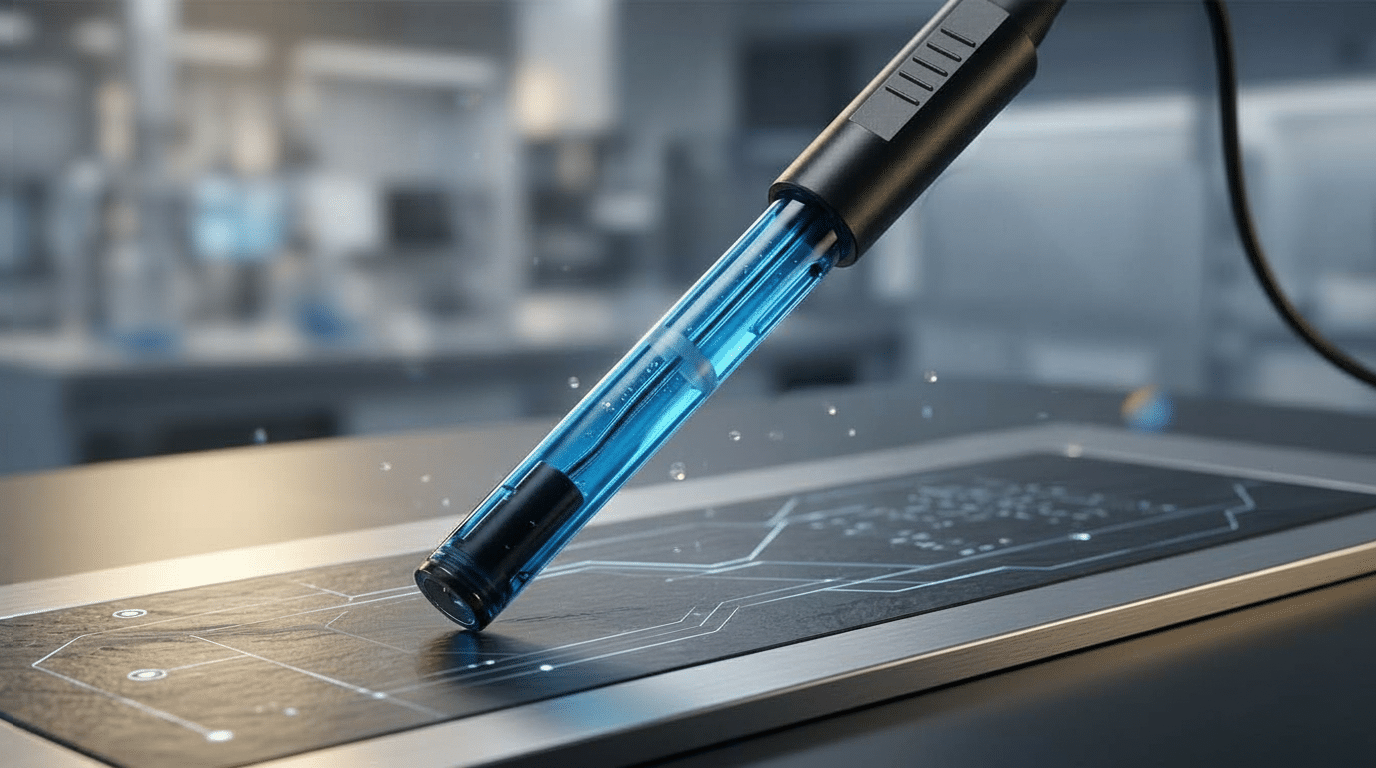
We manufacture ISE electrodes to order, which is why you won’t find them in the online shop. Which ion you’re measuring, in what concentration range, at what temperature and pH value, and which interfering ions are present in the medium determine the design. Describe your measuring point to us, and we’ll suggest the right electrode and send a quote.
What Is an Ion-Selective Electrode?
An ion-selective electrode works on the same principle as a pH electrode, except its membrane doesn’t respond to hydrogen ions but to a specific other ion. A potential develops at the membrane that changes with the concentration of that ion. Measured against a reference electrode, this yields a value in mol/L or mg/L.
In practice, ISE electrodes differ mainly by membrane material. It determines which ion is measured, how sensitive the electrode is, and how long it lasts. Three membrane types cover the entire range:
- Ultra-durable PVC membrane for calcium, potassium, ammonium, and nitrate. At Apera, built with solid electrolyte, a reservoir of active material, and Dry-Node technology.
- Solid-state membrane for chloride, bromide, iodide, copper, silver, and sulfide, as well as lead, cadmium, and mercury. Rugged and usable across wide concentration ranges.
- Single-crystal membrane for fluoride. Highly selective and usable from 10-6 to 10-1 mol/L.
Combination Electrode or Measuring Electrode?
In a combination electrode, the measuring and reference electrodes sit in a single shaft. This is the usual choice for process measurement, since only one electrode needs to be mounted and maintained. A measuring electrode, also called a half-cell, contains only the ion-sensitive part and always requires a matching separate reference electrode. It makes sense when an existing reference electrode is reused or a special measuring setup is needed.
Which Ions Can You Measure?
13 ions are available as a combination electrode and as a measuring electrode. The code in the second column is appended to the model designation, for example IndSen2071S-CA for a digital calcium combination electrode.
| Ion | Code | Membrane | Range mol/L | Range mg/L | Temperature | pH Range |
|---|---|---|---|---|---|---|
| Calcium Ca2+ | CA | Ultra-durable PVC membrane | 5 × 10⁻⁶ to 10-1 | 0.20 to 4008 | 5 to 50 °C | 4 to 11 |
| Potassium K+ | K | 10-6 to 1 | 0.039 to 3910 | 5 to 50 °C | 1 to 9 | |
| Ammonium NH4+ | NH | 10-5 to 0.5 | 0.18 to 9000 | 5 to 50 °C | 2 to 8.5 | |
| Nitrate NO3– | NO | 10-5 to 1 | 0.62 to 62000 | 5 to 50 °C | 4.6 to 8 | |
| Fluoride F– | F | Single-crystal membrane | 10-6 to 10-1 | 0.019 to 1900 | 5 to 45 °C | 5 to 6 |
| Chloride Cl– | CL | Solid-state membrane | 5 × 10⁻⁵ to 10-1 | 1.775 to 3550 | 5 to 60 °C | 2 to 11 |
| Bromide Br– | BR | 5 × 10⁻⁶ to 10-1 | 0.40 to 7990 | 5 to 60 °C | 2 to 11 | |
| Iodide I– | I | 5 × 10⁻⁷ to 10-1 | 0.0635 to 12690 | 5 to 60 °C | 2 to 11 | |
| Copper Cu2+ | CU | 5 × 10⁻⁷ to 10-1 | 0.032 to 6355 | 5 to 60 °C | 3 to 7 | |
| Silver Ag+ | AG | 10-6 to 1 | 0.11 to 108000 | 5 to 80 °C | 1 to 9 | |
| Sulfide S2- | S | 10-6 to 1 | 0.03 to 32000 | 5 to 50 °C | 13 to 14 | |
| Lead Pb2+ | PB | 10-5 to 10-1 | 2.1 to 21000 | 5 to 80 °C | 3 to 7 | |
| Cadmium Cd2+ | CD | 10-6 to 10-1 | 1.1 to 11000 | 5 to 80 °C | 3 to 7 | |
| Mercury Hg2+ | HG | 10-6 to 1 | 2 to 200000 | 5 to 80 °C | 0 to 2 |
Is your ion not listed, or are you unsure about the concentration range? Write to us about which medium you’re measuring and what range you expect. We’ll check whether an ISE is the right method.
Why Do Our PVC Membranes Last Longer?
Conventional PVC membranes are not very stable or durable, and the electrode’s service life is only 3 to 6 months. The IndSen electrode with an ultra-durable PVC membrane uses a solid electrolyte, a reservoir of active material, and a more rugged construction. This gives it a 2 to 3 times longer service life; we guarantee 12 months of durability with a 6-month warranty.
| Feature | Ultra-durable PVC Membrane | Conventional PVC Membrane |
|---|---|---|
| PVC membrane | About 1.2 mm thick, no indentation | 0.3 to 0.8 mm thick, the surface can bulge or dent |
| Ion-active material | Reservoir of active material that significantly extends service life | Only in the PVC membrane, the active material is used up quickly |
| Reference electrode | Solid electrolyte, non-flowing and non-volatile, stabilizes the membrane | Liquid electrolyte, easily volatile, does not support the membrane |
| Preparation before measurement | No soaking needed, or only a few minutes | Hours of soaking required |
| Service life | 12-month durability, 6-month warranty | Durability under 6 months |

How Is an Industrial ISE Electrode Constructed?
Four components determine how reliably an ISE measuring point works in the process.
- Measuring electrode: depending on the ion, an ultra-durable PVC membrane, a solid-state membrane, or a single-crystal membrane. For pH, there is additionally the glass membrane electrode.
- Reference electrode: double diaphragm, long-life reference system, and reference gel shield the system against ingress of contamination and keep the reference potential stable over long service periods.
- Signal output: RS485 digital signal, 4 to 20 mA, 0 to 5 V, or a classic analog signal. The RS485 digital module operates with galvanic isolation.
- Electrode assembly: automatic temperature compensation via an integrated temperature sensor and optionally a solution grounding electrode against ground-potential errors. Housing made of PC, M22 × 1.5 thread, with protective cap and sealing ring.
Which Version Fits Your Measuring Point?
Three designs cover industrial use. The model designation always ends with the ion’s code, and an appended -T indicates automatic temperature compensation.
IndSen 2071S, Digital Combination Electrode
The first choice for plants with a bus system and central display. It provides an RS485 digital signal with galvanically isolated power supply, has automatic temperature compensation and solution grounding as standard, and is available with all three membrane types. Examples: IndSen2071S-CA, IndSen2071S-CL, IndSen2071S-F.
IndSen 2071M, Analog Combination Electrode
Fits existing transmitters with an analog input. With the -T suffix, it works with automatic temperature compensation; solution grounding is optional. Examples: IndSen2071M-CA-T, IndSen2071M-CL, IndSen2071M-F-T.
IndSen 1121M, ISE Measuring Electrode
A half-cell with an analog signal, without an integrated reference electrode. It requires a matching separate reference electrode, and temperature compensation is handled by the transmitter. Examples: IndSen1121M-CA, IndSen1121M-CL, IndSen1121M-F.
How to Read the Model Designation
| Example | Design | Ion | Suffix |
|---|---|---|---|
| IndSen2071S-CA | Digital combination electrode | Calcium | Temperature compensation and solution grounding as standard |
| IndSen2071M-NO-T | Analog combination electrode | Nitrate | -T means automatic temperature compensation |
| IndSen2071M-CL | Analog combination electrode | Chloride | without automatic temperature compensation |
| IndSen1121M-F | Measuring electrode, half-cell | Fluoride | separate reference electrode required |
What Affects Measurement Stability?
The accuracy and stability of industrial ISE measurements depend not only on the electrode, but equally on how interfering influences are eliminated. We clarify these five points with you before an electrode is selected.
| Influencing Factor | Remedy |
|---|---|
| Contaminants in the solution | Remove contaminants with a filter, clean the electrode tip regularly with a soft brush |
| Temperature | Route the solution into a measuring vessel where the temperature can be adjusted |
| Ionic strength and interfering ions | Dose an ionic strength adjustment buffer via a proportional pump |
| pH value of the solution | Adjust the pH value in the measuring cell or dose it via a proportional pump |
| Drift after extended measurement periods | Regular manual calibration and maintenance, or an automatic calibration device at fixed intervals |
Ion Measurement in the Lab Instead of in the Process
The IndSen series is designed for continuous measurement in the running process. If you measure samples in the lab instead, our LabSen electrodes are the right choice. You’ll find them directly in the shop.
Frequently Asked Questions About Ion Measurement
Why can’t I order ISE electrodes directly?
Each ISE electrode is tailored to a specific ion, a concentration range, and the conditions at your measurement site. Membrane type, signal output, temperature compensation, and solution grounding result in a vast number of combinations that cannot be practically kept in stock. That is why we manufacture to order and will provide you with a customized quote.
How accurate is an ISE measurement?
An ISE measures the activity of the ion, not its concentration directly. Accuracy and reproducibility therefore depend heavily on how constant the ionic strength, pH, and temperature of the sample are. By using an ionic strength adjustment buffer, a temperature-controlled measuring vessel, and regular calibration, you can achieve highly reproducible values in process measurement. For trace analysis in the lower range of the table, laboratory analysis remains the more accurate method.
Do I need a solution grounding electrode?
A solution grounding electrode is recommended whenever ground potentials or electrostatic interference may occur in the vessel, such as with agitators, pumps, or high-flow plastic piping. It is included in the IndSen 2071S digital model; for the analog models, it is optional.
How long does an ISE electrode last?
With the ultra-strong PVC membrane, we guarantee a service life of 12 months with a 6-month warranty. Conventional PVC membranes typically last less than 6 months. Solid-state and single-crystal membranes are more durable and generally last longer; the key factors here are contamination and mechanical stress on the measuring surface.
Do I need to soak the electrode in water before the first measurement?
With the ultra-strong PVC membrane, no soaking is required—or only a few minutes—and the electrode is ready for use almost immediately. Conventional PVC membranes, on the other hand, must be soaked for hours. For solid-state and single-crystal membranes, a brief rinse and calibration with two standards are usually sufficient.
Please describe your measurement site to us
The more we know about the measurement point, the more accurate our recommendation will be. The following information is helpful: which ion is to be measured, the expected concentration range, the temperature and pH of the medium, possible interfering ions, the existing transmitter, and whether solution grounding is required.
Apera Instruments (Europe) GmbH, Wilhelm-Muthmann-Straße 18, 42329 Wuppertal
Phone +49 (0)202 51988998, Email info@aperainst.de, Mon–Fri from 8:30 a.m. to 5:00 p.m.