

Apera manufactures pH and ORP electrodes specifically for pool and spa water. A robust glass membrane, a double diaphragm to resist fouling, and a reference system without silver ions ensure that measurements remain stable even under continuous operation.
Four electrodes are available immediately from our shop. All other versions are made to order — simply send us a request.
We’ll recommend the right version and send you a quote.
These four electrodes can be ordered directly
We stock the most requested versions for pools and spas. They can be ordered from our shop, with either a 1 m or 2 m cable.
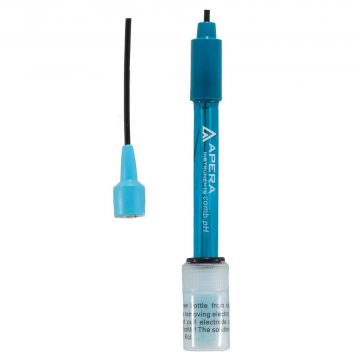
201DJ-C pH electrode, BNC, 1 m
Double-junction combination pH electrode, polycarbonate and glass.
Item no. 28APE190144 / AI3115
€51.17
201DJ-C/2 pH electrode, BNC, 2 m
Double-junction combination pH electrode with 2 m cable.
Item no. 28APE190458
€53.43
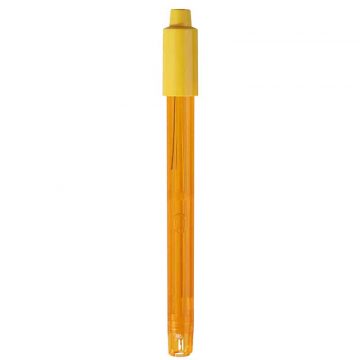
301DJ-C ORP electrode, 1 m
Plastic ORP combination electrode with platinum pin.
Item no. 28APE190334 / AI3125
€82.11
301DJ-C/2 ORP electrode, 2 m
Plastic ORP combination electrode with 2 m cable.
Item no. 28APE190508
€84.37
All prices in euros, including VAT, plus shipping.
All other versions are made to order. Other connectors, other cable lengths, electrodes with a temperature sensor, or the lead-free glass series are not kept in stock. Tell us which pool or basin you’re monitoring and what connector your meter uses, and you’ll receive a recommendation and a quote.
What an electrode for pool water needs to deliver
An electrode consists of a glass membrane, a diaphragm, inner and outer reference electrolyte, and a reference electrode. All four components in Apera’s pool electrodes are designed for chlorine exposure, continuous operation, and changing water quality. This results in three key figures that make the difference in everyday use:
- Fast response: 95% of the reading is reached after 10 seconds at 25 °C.
- High accuracy: the factory slope of the pH electrode is 97%.
- Low drift: long-term stability is under 10 mV, equivalent to 0.15 pH.
Robust glass membrane
The glass membrane detects the activity of hydrogen ions (H+) in the water and is the core technology of every electrode. The membrane in Apera’s pool electrodes is 10 times more robust than conventional glass membranes and combines low impedance with high stability. This makes it suitable for continuous monitoring in pools and spas.
Double diaphragm instead of simple ceramic
A single ceramic diaphragm lets the electrolyte leak out slowly and evenly, but it’s prone to fouling and clogging. That’s why the pool electrodes mostly use a double electrolyte structure, which significantly reduces this risk. This is reflected in the product name as “Double Junction.”

Long-lasting reference without silver ions
To keep the reference electrode stable over the long term, the reference electrolyte contains no silver ions. This avoids reactions with sulfides or proteins in the sample solution, which would otherwise clog the diaphragm.
Macromolecule coating for stable redox readings
Platinum and gold surfaces develop a thin oxide layer during storage and use and become contaminated, which changes the measurement interface. Apera’s macromolecule coating shields them from the environment: the electrode responds significantly faster, readings are largely stable after about 2 minutes, and different ORP electrodes deliver much more consistent values.
- Chemically resistant, releases no particles or breakdown products into the medium.
- Heat-resistant up to 190 °C.
- High ion conductivity and pronounced proton-exchange function.
- Selectively permeable — after water uptake, only hydrogen ions pass through.
pH electrodes for pool water
Two series cover the pool segment. The 201DJ and 203DJ series in a polycarbonate housing is the standard for pools and spas. The IndSen 710 series in lead-free glass is designed for higher temperatures up to 100 °C and more demanding installations.
201DJ and 203DJ series
Available versions: 201DJ-C (BNC, 12 × 120 mm), 201DJ-CBS (BNC, 12 × 83 mm), 201DJ-S7 (S7), 203DJ-C (BNC), and 203DJ-F (BNC+RCA). The 201DJ-C is available in the shop; the other versions are available on request.
| Feature | 201DJ series | 203DJ series |
|---|---|---|
| Measuring range | 0 to 14 pH | 0 to 14 pH |
| Temperature | 0 to 80 °C | 0 to 80 °C |
| Housing material | PC (polycarbonate) | PC (polycarbonate) |
| Diaphragm | Double diaphragm: ceramic / foam plastic | Double diaphragm: ceramic / ceramic |
| Reference | Ag/AgCl | Long-life reference |
| Electrolyte | Gel without AgCl or AgCl-saturated gel | Gel I and gel without AgCl |
| Temperature sensor | not available | 203DJ-C: no, 203DJ-F: optional |
| Dimensions | 12 × 120 mm, 201DJ-CBS: 12 × 83 mm | 12 × 120 mm |
| Connector | BNC, 201DJ-S7: S7 | BNC, 203DJ-F: BNC+RCA |
IndSen 710 series
pH electrodes made of lead-free glass with a ceramic/ceramic double diaphragm and long-life reference, usable up to 100 °C. This series is fully available on request.
| Feature | IndSen 711 | IndSen 712 | IndSen 714 | IndSen 716 |
|---|---|---|---|---|
| Measuring range | 0 to 14 pH | |||
| Temperature | 0 to 100 °C | |||
| Housing material | Lead-free glass | |||
| Diaphragm | Double diaphragm: ceramic / ceramic | |||
| Reference | Long-life reference | |||
| Electrolyte | Gel I and gel without AgCl | |||
| Temperature sensor | optional | no | optional | no |
| Connector | BNC | S7 | PG13.5 / BNC | S8 |
| Dimensions | 12 × 120 mm | |||
ORP electrodes for disinfection control
The redox potential shows how effectively the disinfectant is working in the pool. Depending on the application, platinum or gold sensors are used, as a pin, film, or ring.
| Type | Design | Measuring range | Temperature range | Application |
|---|---|---|---|---|
| Platinum | Pin, film, or ring | ±2000 mV | -10 to 135 °C | Chromate reduction, nitrite oxidation, disinfection of pool and drinking water |
| Gold | Pin, film, or ring | ±2000 mV | -10 to 135 °C | Cyanide oxidation, water disinfection |
301DJ, 303DJ, and 306DJ series
Available versions: 301DJ-C (platinum pin), 301DJ-CS (platinum pin, 12 × 83 mm), 303DJ-C (platinum film), 303DJ-C-G (gold film), and 306DJ-C-G (gold ring). The 301DJ-C is available in the shop; the other versions are available on request.
| Feature | 301DJ series | 303DJ series | 306DJ series |
|---|---|---|---|
| Measuring range | ±2000 mV | ±2000 mV | ±2000 mV |
| Temperature | 0 to 80 °C | 0 to 80 °C | 0 to 80 °C |
| Housing material | PC (polycarbonate) | PC (polycarbonate) | PC (polycarbonate) |
| Diaphragm | Double diaphragm: ceramic / foam plastic | Double diaphragm: ceramic / ceramic | Double diaphragm: ceramic / ceramic |
| Reference | Ag/AgCl | Long-life reference | Long-life reference |
| Electrolyte | Gel without AgCl or AgCl-saturated gel | Gel I and gel without AgCl | Gel I and gel without AgCl |
| Sensor | Platinum pin or gold pin | Platinum film or gold film | Platinum ring or gold ring |
| Dimensions | 12 × 120 mm, 301DJ-CS: 12 × 83 mm | 12 × 120 mm | 12 × 120 mm |
| Connector | BNC | BNC | BNC |
IndSen 3710 series
ORP electrodes made of lead-free glass with a platinum or gold ring, usable up to 100 °C. This series is fully available on request.
| Feature | IndSen 3711 | IndSen 3712 | IndSen 3714 | IndSen 3716 |
|---|---|---|---|---|
| Measuring range | ±2000 mV | |||
| Temperature | 0 to 100 °C | |||
| Housing material | Lead-free glass | |||
| Diaphragm | Double diaphragm: ceramic / ceramic | |||
| Reference | Long-life reference | |||
| Electrolyte | Gel I and gel without AgCl | |||
| Sensor | Platinum ring or gold ring | |||
| Connector | BNC | S7 | PG13.5 / BNC | S8 |
| Dimensions | 12 × 120 mm | |||
Calibration, standard, and storage solutions
Regular calibration and proper storage keep an electrode accurate for years. The right solutions can be purchased directly from our shop; they are available in 250 ml bottles.
- pH calibration buffers: pH 4.00, pH 7.00, and pH 10.01, 250 ml each.
- ORP standard solutions: 222 mV, 470 mV, and 650 mV, 250 ml each.
- Storage solution: 3M KCl for pH and ORP electrodes, 250 ml.
You’ll find the available calibration, standard, and storage solutions in our shop.
Which connector fits your meter?
The electrodes are available with the standard connectors used in pool technology. If you’re not sure which connector your system uses, simply send us a photo of the socket along with your inquiry.
| Connector | Description |
|---|---|
| BNC | Standard connector on most measuring and control devices |
| S7 | Screw head, common on dosing systems |
| S7-BNC cable | Connecting cable from S7 head to BNC |
| BNC + RCA | Additional RCA contact for the temperature sensor |
| PG13.5 / BNC | PG13.5 process thread with BNC signal connector |
| S8 | Screwed head for fixed installations |
Frequently Asked Questions About Electrodes for Swimming Pools and Spas
Why are only four electrodes available for order in the store?
We keep the four most popular models for swimming pools and spas in stock; they’re available for immediate purchase. All other models differ in terms of connections, cable length, sensor material, or temperature probes and are custom-made to order. That’s why you’ll receive a custom quote for them instead of a list price.
What kind of electrode do I need for my pool?
To control the dosing system, you generally need a pH electrode and an ORP electrode. The key factors are the connection type of your measurement and control unit—usually BNC or S7—as well as the required cable length. If you’re unsure, send us the manufacturer and model of your system, and we’ll match it with the appropriate electrode.
How often do I need to calibrate?
During normal operation, we recommend calibrating the pH electrode every four to eight weeks; more frequently if the water is highly contaminated. Check the ORP electrode using a standard solution of 222, 470, or 650 mV. After calibration, the electrode should be stored again in 3M KCl storage solution—never dry and never in distilled water.
How long does a swimming pool electrode last?
That depends on water quality, temperature, and maintenance. The glass membrane in Apera pool electrodes is 10 times more durable than conventional membranes; the double diaphragm reduces fouling and clogging; and the silver-ion-free reference electrolyte prevents reactions with sulfides or proteins. If the slope drops significantly despite calibration, or if the reading takes a long time to stabilize, it’s time to replace the electrode.
What does “Double Junction” mean?
“Double Junction” refers to the double diaphragm. A second electrolyte chamber is located between the measuring solution and the reference electrode. As a result, contaminants from the pool water reach the reference electrode much more slowly, the electrode remains stable longer, and the diaphragm clogs less frequently.
We’ll find the right electrode for your system
Can’t find what you need in the store? Just send us a quick message telling us which tank you’re monitoring, which measurement and control device you’re using, what type of connection it has, and what cable length you need. We’ll send you a recommendation and a quote.
Apera Instruments (Europe) GmbH, Wilhelm-Muthmann-Straße 18, 42329 Wuppertal
Phone +49 (0)202 51988998, Email info@aperainst.de, Mon–Fri from 8:30 a.m. to 5:00 p.m.