

A conductivity meter measures how well water conducts electricity and, by extension, how many dissolved salts it contains. It sounds simple, but things can quickly get confusing when you’re shopping: One meter displays only EC, the next also shows TDS and salt content, and the third even measures the pH level. And prices range from under 100 euros to well into the three-digit range. This buying guide compares Apera conductivity meters based on their actual technical specifications and tells you which meter is best suited for which application.
We explain in detail how the measurement works technically and how to calibrate correctly in “How Do I Measure Conductivity?”.
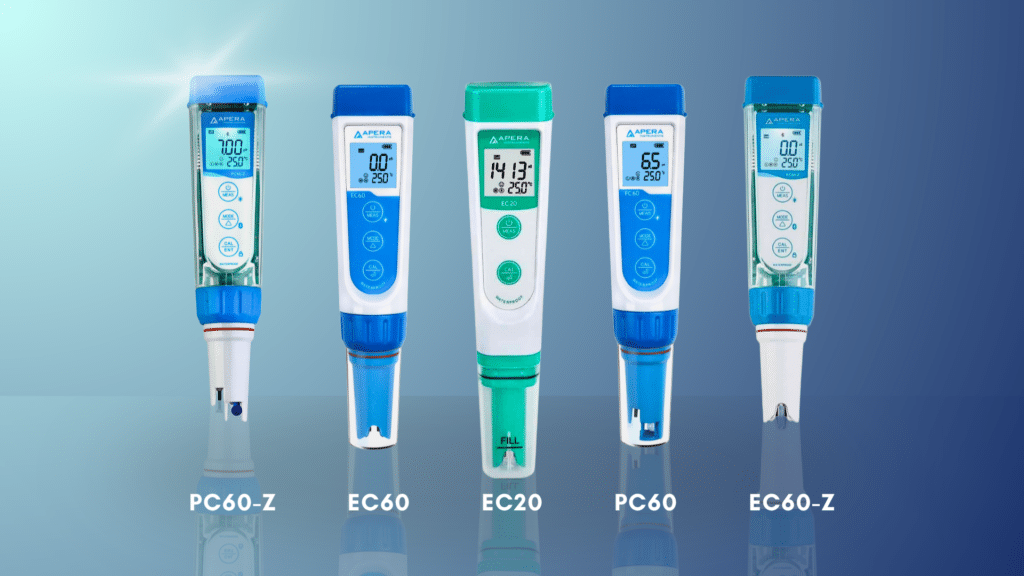
At a Glance: A Comparison of the Devices
All devices compared here feature automatic temperature compensation in the range of 0 to 50 °C, are IP67-rated for water resistance and floatable, and have an accuracy of ±1% of the full-scale value. The differences lie in the additional parameters, the replaceable electrode, and data logging.
| Device | Measures | EC measurement range | Resolution | Replaceable electrode | Price + 19% VAT included |
|---|---|---|---|---|---|
| EC20 Value | EC, Temperature | 0 to 200 µS/cm; 0 to 2000 µS/cm; 0 to 20 mS/cm | 0.1/1 µS/cm; 0.01 mS/cm | No | 83.30 € |
| EC60 Premium | EC, TDS, Salinity, Temperature | 0 to 199.9 µS/cm; 200.0 to 1,999 µS/cm; 2 to 20.00 mS/cm | 0.1/1/10 µS/cm | Yes (EC60-E) | 127.33 € |
| EC60-Z Smart | EC, TDS, salinity, resistance, temperature | 0 to 199.9 µS/cm; 200.0 to 1999 µS/cm; 2.0 to 20.00 mS/cm | 0.1/1/10 µS/cm | Yes (EC60-DE) | 172.55 € |
| PC60 Premium | pH, EC, TDS, salinity, temperature | 0 to 20.00 mS/cm | 0.1/1/10 µS/cm | Yes (PC60-E) | 208.25 € |
| PC60-Z Smart | pH, EC, TDS, salinity, resistance, temperature, ORP (optional) | 0 to 20.00 mS/cm | 0.1/1/10 µS/cm | Yes (PC60-DE) | 232.05 € |
Each device comes as a complete set with calibration solutions (1413 µS/cm and 12.88 mS/cm), batteries, a carrying strap, and a carrying case. Battery life is up to 1,000 hours with 4 AAA batteries; all devices come with a two-year manufacturer’s warranty, and the electrode has a six-month warranty.
What You Should Really Look for When Buying
Replaceable electrode
This is the most important point, which is often overlooked when comparing prices. The electrode is the wear-and-tear part, not the device itself. With the EC60, EC60-Z, PC60, and PC60-Z, you can replace the electrode individually and continue using the meter. With the EC20, the electrode is permanently installed, so when it reaches the end of its service life, the entire device needs to be replaced. If you take measurements daily, a replaceable system will save you money in the long run.
Measurement Range and Resolution
Resolution determines whether you can detect small changes at all. With very clean water—such as that downstream of a reverse osmosis system—you’ll be dealing with values in the low double-digit µS/cm range. Meters with a resolution of 0.1 µS/cm in the lower range can still display meaningful differences there. In the upper range, all devices are rated up to 20 mS/cm, which covers nutrient solutions, brackish water, and most process waters.
Interpreting Accuracy Correctly
±1% F.S. means one percent of the full-scale range, not of the displayed value. In the range up to 2000 µS/cm, this corresponds to a tolerance of about 20 µS/cm. This is perfectly adequate for hydroponics, aquariums, and drinking water testing. For applications where the third decimal place matters, you’ll need a benchtop or laboratory meter instead of a Pocket Tester.
Calibration and Temperature Compensation
Conductivity is highly temperature-dependent. Without automatic temperature compensation, the same water will measure significantly differently at 15 °C than at 25 °C. All Apera devices automatically compensate in the range of 0 to 50 °C and automatically recognize the calibration solution, so you don’t have to enter values manually.
Do you really need more than EC?
TDS and salinity aren’t measured separately but are calculated based on conductivity. So a device with three displays isn’t three times as good a meter—it just saves you the trouble of doing the calculations. You can find out what each value means on our pages about TDS and salinity.
EC20 or EC60: The Most Common Comparison
Both devices measure conductivity with the same accuracy of ±1% F.S. and use the same platinum electrode technology. The difference lies elsewhere:
- EC20 (70 euros): A pure conductivity meter with temperature display. Built-in electrode, 1- to 2-point calibration, large LCD. The right choice if you regularly check a single value and aren’t interested in TDS or salinity.
- EC60 (107 euros): Displays EC, TDS, salinity, and temperature simultaneously; features a two-color display (blue in measurement mode, green in calibration mode) and the replaceable EC60-E electrode. The TDS factor can be adjusted between 0.40 and 1.00, which is important if you need to follow a fertilizer manufacturer’s specifications.
With the EC60, you’ll recoup the 37-euro surcharge by the time you change the electrodes for the first time, at the latest. Choose the EC20 if the device is used only occasionally or is intended as a backup unit.
When a multiparameter device is worth it
As soon as you need to measure pH regularly in addition to conductivity, a single device becomes impractical: two devices, two calibration routines, two sets of solutions. The PC60 measures pH, EC, TDS, salinity, and temperature with a single interchangeable multiparameter electrode. The pH range is -2.00 to 16.00 with an accuracy of ±0.01 pH and automatic 1- to 3-point calibration. Compared to using the EC60 in combination with a separate pH meter, you save space, time, and a second calibration procedure.
Typical applications for a multiparameter device include hydroponics (EC for nutrient concentration, pH for nutrient availability), aquariums, and process control in food processing.
Smart Devices with an App: EC60-Z and PC60-Z
The Z Series adds Bluetooth connectivity to the ZenTest app to the premium devices. The practical benefit lies less in the display itself and more in the documentation: measurement and calibration data are automatically saved to the cloud and can be shared directly via email. For those who need to log measurement values anyway, this eliminates the need for manual transcription. Both devices also work without a smartphone.
In addition, the EC60-Z and PC60-Z measure resistivity from 50 Ω·cm to 20 MΩ·cm. This is the measurement of choice when dealing with very pure water, such as that produced by reverse osmosis or ion exchange systems. The PC60-Z also measures ORP; the ORP60-DA electrode is required for this. You can find more information about the app on the ZenTest App page.
Recommendation by Application
| Usage | Recommendation | Why |
|---|---|---|
| Hydroponics, indoor cultivation | PC60 or EC60 | EC and pH go hand in hand in the nutrient solution; EC60 is sufficient if the pH is already properly balanced |
| Aquariums, Ponds | EC60 | EC, TDS, and salinity in a single device, with a replaceable electrode for continuous operation |
| Drinking water, reverse osmosis | EC60-Z | Resistivity measurement up to 20 MΩ·cm for ultra-pure water |
| Laboratory, documentation required | PC60-Z | All relevant parameters plus automatic logging in the app |
| Occasional inspection | EC20 | The most affordable entry-level option with the same measurement accuracy |
You can find specific target values for growing in the ” EC Values in Hydroponics” guide, and an overview of all devices on the conductivity (EC) page.
Conclusion
For most users, the EC60 offers the best balance: a replaceable electrode, three measured values from a single test, and a price that’s significantly lower than that of a multiparameter meter. The EC20 is the right choice for occasional use; the PC60 is ideal when pH measurement is required; and the Z models are recommended when measurement results need to be documented or when dealing with very pure water. The price has no effect on measurement accuracy; all devices have an accuracy of ±1% F.S.
Frequently Asked Questions
What is the difference between EC, TDS, and salinity?
Electrical conductivity is always measured. TDS and salinity are then converted from this value using a factor. So a device that displays all three values doesn’t actually take three separate measurements—it simply converts the values for you. For the TDS value, you can set the conversion factor on the EC60, EC60-Z, PC60, and PC60-Z between 0.40 and 1.00.
How often do I need to calibrate a conductivity meter?
Once a week for daily use; before each series of measurements for occasional use. All Apera devices automatically detect the calibration solution, and the process takes less than a minute. Details can be found in “How do I measure conductivity?”
What does an accuracy of ±1% F.S. mean?
F.S. stands for “full scale,” meaning the maximum value of the respective measurement range. In the range up to 2000 µS/cm, one percent corresponds to approximately 20 µS/cm. The deviation therefore refers to the range, not to the individual measured value.
Which device is suitable for reverse osmosis water?
The EC60-Z, because it also measures specific resistance up to 20 MΩ·cm. In very pure water, resistance is a more meaningful parameter than conductivity.
Can I purchase the electrode separately?
Yes, for the EC60 (EC60-E), EC60-Z (EC60-DE), PC60 (PC60-E), and PC60-Z (PC60-DE). The electrode in the EC20 is permanently installed and cannot be replaced.